01 — Overfishing

We're catching fish faster than the ocean can replace them.

About a third of the world's fish stocks are being pushed past what they can handle. If nothing changes, empty oceans could be a thing in our lifetime.

0%
of large predatory fish are gone

Compared to pre-industrial baselines

$0B
in harmful fishing subsidies / year

Driving fleets to overfish

0%
of global catch is bycatch

Dolphins, turtles, sharks — discarded

Interactive
How much fishing can the ocean take?

Drag the slider below to set how hard humans fish this patch of ocean. Low = a few boats. High = industrial fleets taking fish faster than they can reproduce. Watch the fish disappear and the ecosystem label change.

← Drag me · Fishing intensity50%
NoneSustainableOverfishedCollapse
Fish remaining
48%
Ecosystem
Stressed

Drag the slider. The fish are simplified — the impact isn't.

So what is overfishing, really?

Basically, it's when we catch fish faster than they can have babies. And it's not just about running out of fish for dinner — whole ecosystems collapse, coastal towns lose their jobs, and the 3 billion people who count on the sea for food are left with nothing.

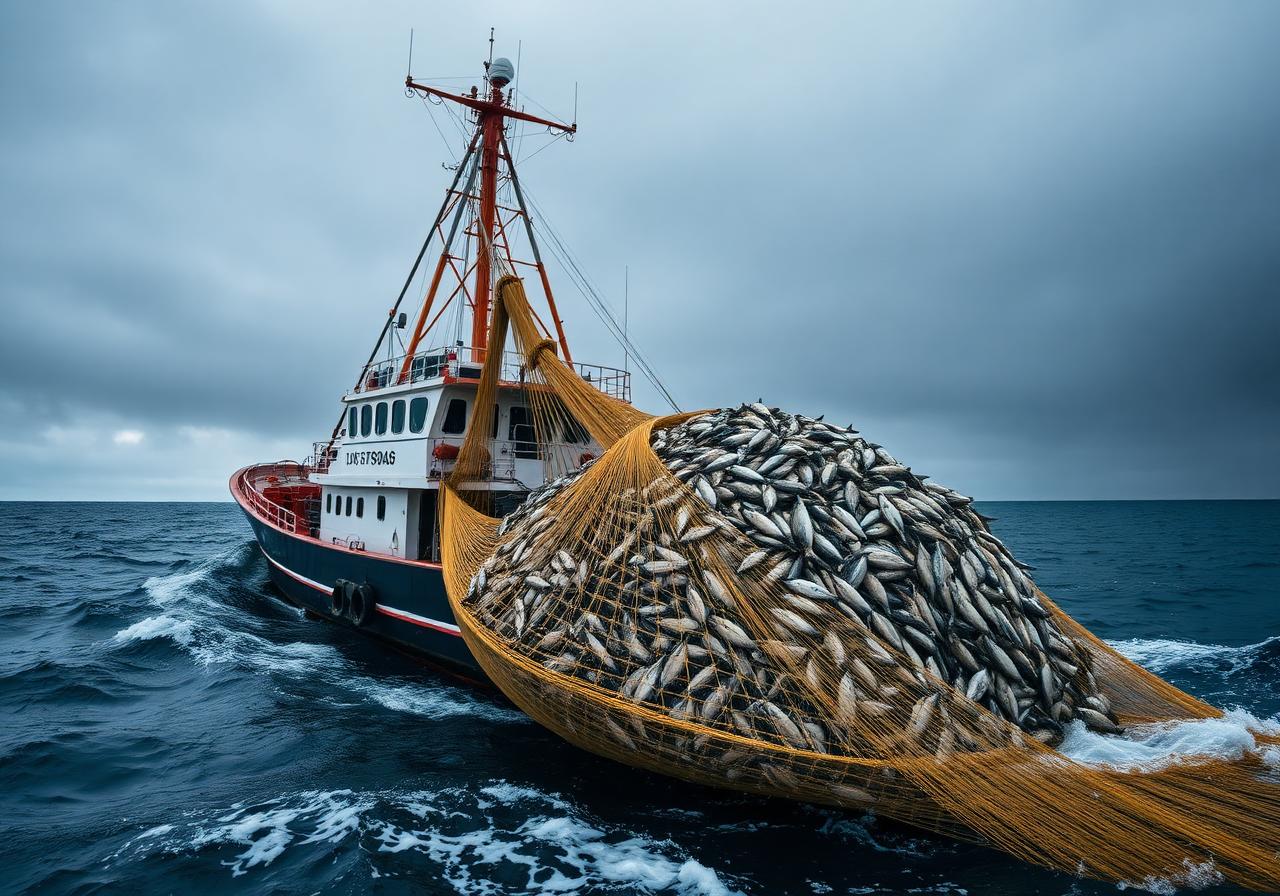
Industrial trawling

Bottom trawlers drag weighted nets across the seafloor, flattening centuries-old habitats in a single pass. A single trawl can release as much carbon as global aviation in a year.

Bycatch

For every kilogram of shrimp caught, up to ten kilograms of other animals die in the net — sharks, dolphins, turtles, juvenile fish — and are dumped overboard.

IUU fishing

Illegal, unreported and unregulated fishing accounts for up to one in five fish sold worldwide, undermining sustainable fleets and stripping developing nations of food and income.

Subsidies that destroy

Governments pour roughly $22 billion a year into fuel and capacity subsidies that keep oversized fleets at sea — often fishing waters that should be left to recover.

What SDG 14 says about it

Targets 14.4 and 14.6 are the ones that matter here. They tell countries to stop overfishing, rebuild fish populations, and scrap the subsidies making it worse. In 2022 the WTO actually agreed to do this — but whether they stick to it is another story.

References

Sources & citations

Harvard referencing style (generated via MyBib). All figures on this page are drawn from the publications below.

  1. Food and Agriculture Organization of the United Nations (2024) The State of World Fisheries and Aquaculture 2024 — Blue Transformation in action. FAO, Rome. Available at: https://www.fao.org/publications/home/fao-flagship-publications/the-state-of-world-fisheries-and-aquaculture/en (Accessed: 15 June 2026).
  2. Myers, R.A. and Worm, B. (2003) Rapid worldwide depletion of predatory fish communities. Nature, 423(6937), pp. 280–283. Available at: https://www.nature.com/articles/nature01610 (Accessed: 15 June 2026).
  3. Pérez Roda, M.A. (ed.) (2019) A third assessment of global marine fisheries discards. FAO Fisheries and Aquaculture Technical Paper No. 633, Rome. Available at: https://www.fao.org/3/CA2905EN/ca2905en.pdf (Accessed: 15 June 2026).
  4. Sumaila, U.R., Skerritt, D.J., Schuhbauer, A. et al. (2021) Updated estimates and analysis of global fisheries subsidies. Marine Policy, 109, 103695. Available at: https://doi.org/10.1016/j.marpol.2019.103695 (Accessed: 15 June 2026).
  5. United Nations (2023) The Sustainable Development Goals Report 2023: Special Edition — Goal 14: Life Below Water. United Nations, New York. Available at: https://unstats.un.org/sdgs/report/2023/Goal-14/ (Accessed: 15 June 2026).